

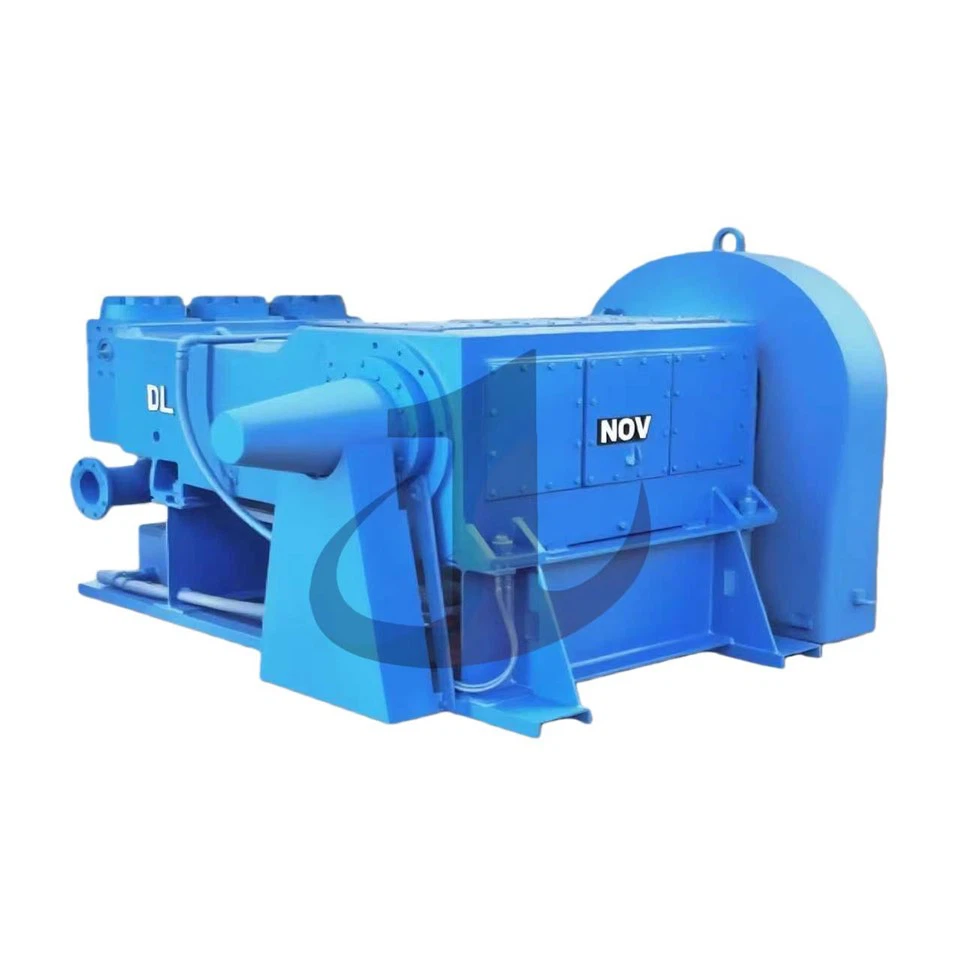


Hydraulic End:Forging to Resist Fatigue
The hydraulic end is the core component of the mud pump that directly withstands high-pressure and abrasive fluid impact. Its design quality directly determines the pump's lifespan and reliability. The JWS-400's hydraulic end incorporates multiple industry-leading technologies, aiming to fundamentally resolve the most common failure modes.
Segmented Forging Alloy Steel Structure: The Cornerstone of Reliability
The hydraulic end of JWS-400 features a modular design, with each module being fully forged from high-strength alloy steel (35CrMo or 40CrMnMo). Compared to traditional cast or monoblock hydraulic ends, this modular forging structure offers unparalleled advantages.
Secondly, the modular design fundamentally alters stress distribution. In traditional monolithic hydraulic end assemblies, cracks originating from stress concentration zones (e.g., cross holes) in a cylinder bore may rapidly propagate through the continuous metal matrix to adjacent cylinders, potentially causing the entire expensive hydraulic end to fail. The JWS-400's modular design, however, creates physical isolation between cylinders, confining stress to individual modules.
Advantages of Cage Valve: Excellent Fluid Dynamics and Unparalleled Durability
A defining feature of the JWS-400 is its advanced Caged Valve, representing a major innovation over traditional wing-guided valve designs to enhance performance and extend service life.
The core of a cage valve is a "cage" that surrounds the valve core (usually a ball or disc valve), which precisely guides the movement of the valve core while providing an optimized flow path for the fluid. Its advantages are reflected in the following aspects:
- Enhanced Fluid Dynamics: The open structure of cage valves provides smoother, less restrictive flow paths compared to traditional valves. This effectively reduces turbulence and pressure drop in drilling fluid flow through the valve, significantly decreasing cavitation occurrences. As cavitation is a primary cause of erosion and material spalling in hydraulic end components, its suppression is crucial for extending the service life of these components.
- Enhanced durability: The cage structure provides comprehensive guidance and support for the valve core, reducing lateral loads and irregular impacts during high-speed reciprocation, thereby preventing abnormal wear on the valve seat. More importantly, the cage design enables the use of advanced composite materials (high-performance polymers or specialty alloys) as wear-resistant inserts. These effectively absorb the significant impact forces generated during valve closure, addressing the common "beat-out" issue in traditional metal-to-metal valves and protecting both the valve seat and valve body.
- Simplified maintenance: The cage valve's core, seat, and cage are modularized, enabling quick replacement to reduce on-site maintenance time and lower NPT costs.
High Performance Sealing Technology: Practical Application of Materials Science
Valve assembly is the most frequently replaced wear-prone component in hydraulic end, and its performance directly affects the pump's efficiency and running time. The JWS-400 valve system is a precision system composed of multiple high-performance materials, designed to simultaneously address various failure modes such as wear, corrosion, compression, and impact.
- Valve Insert: Our standard valve insert is crafted from high-performance polyurethane, featuring exceptional wear resistance and compression resistance. It maintains sealing integrity even under pressures up to 5000 PSI (34.5 MPa) or higher. Capable of operating at 180°F (82°C), it also offers special formulations for higher temperatures, making it adaptable to various drilling fluid environments including water-based, oil-based, and synthetic-based systems.
- Valve Seat: Crafted from premium forged alloy steel (AISI 8620) and precision carburizing-quenching heat treatment, this valve seat achieves dual performance characteristics with surface hardness reaching
- The HRC 58-62 material provides sufficient resistance to high-frequency impacts and abrasive wear during valve closure, while its core maintains excellent toughness to absorb impact energy without fracture. This hard exterior and tough interior structure ensures the valve seat's long-term maintenance of its critical sealing geometry, effectively preventing high-pressure leakage.
- Valve Body: Like the valve seat, the valve body is constructed from high-strength forged alloy steel to ensure sufficient strength and fatigue resistance under extreme cyclic pressure.
Power End: The Cornerstone of Strength and Precision
Robust Rack and Drive System: Stability under Load
The JWS-400's power unit features an open-frame design, constructed from precision-engineered high-strength welded steel plates. Compared to traditional cast-iron frames, this welded steel structure delivers superior strength-to-weight ratio at equivalent rigidity. For workover pumps frequently relocated between different well sites, the lighter weight translates to reduced transportation costs and more efficient hoisting operations.
The power is transmitted through a robust 4.667:1 chain drive system. Chain drive is renowned for its high torque capacity and reliability, making it particularly suitable for applications like slurry pumps that require high torque at low speeds.
Forged Crankshaft and Precision Bearing: Coping with Extreme Loads
The core of the power end is its rotating parts, the quality of which determines the stability and life of the pump.
- The crankshaft of JWS-400 is forged from forged alloy steel, and all the journal is precision grinding and polishing. The forging process ensures the crankshaft has the highest fatigue strength, and can bear the huge and continuous cyclic load from the three pistons.
- Main Bearing: The crankshaft's main bearing employs heavy-duty tapered roller bearings (Tapered Roller Bearings), a critical design feature. Unlike straight roller bearings that only withstand radial forces, tapered roller bearings can simultaneously endure substantial radial forces and axial (thrust) loads from the drive end. This design not only simplifies the structure and reduces failure points but, more importantly, provides the crankshaft with exceptional rigidity. It prevents minor deflections under load, thereby avoiding crankshaft fatigue and abnormal gear wear – the cornerstone of the pump's long-term durability.
- The connecting rod is made of high strength stainless steel with excellent strength and corrosion resistance. The cross head is made of high strength stainless steel with excellent vibration damping and wear resistance.
- The smooth and accurate reciprocating motion is ensured by the ductile iron.
Pressure Lubrication System: The Lifeline of Power End
The internal pressure lubrication system consists of an independent chain driven oil pump, a pipeline, a filter and a pressure gauge, which constitute an active forced lubrication circuit.
Compared with the simple splash lubrication, the forced pressure lubrication system can deliver clean and cool lubricating oil to every key moving parts, including the main bearing, pinion bearing, crosshead slide and connecting rod bearing, accurately and continuously.
High performance wear parts: Maximize uptime, minimize total cost of ownership
We understand that the performance and lifespan of wear parts are critical to determining pump operating costs. Therefore, we provide the JWS-400 with a series of wear parts manufactured using top-tier materials and processes, designed to help customers achieve the lowest Total Cost of Ownership (TCO).
New Standard of Cylinder Liner:Choice between High Chromium Bimetallic and Zirconia Ceramic
We provide two high-performance cylinder liner options to meet diverse operational and budgetary needs, empowering customers to make informed decisions based on their Total Cost of Ownership (TCO) models.
- High-Chrome Bi-Metal Liners: This industry-standard solution delivers both high performance and cost-effectiveness. The outer shell is constructed from high-strength 45# forged steel, providing exceptional compressive strength (tensile strength>610 MPa). The inner liner is made of centrifugally cast high-chromium cast iron (Cr content>26%), which, after heat treatment, achieves an inner wall hardness of HRC 62−69, offering outstanding wear resistance and corrosion resistance. Under standard operating conditions, it can last over 800 hours.
- Zirconia Ceramic Liners: A cutting-edge material science solution. The inner liner is crafted from advanced zirconia ceramic, which boasts an exceptional hardness (>HRC 90) far surpassing high-chromium cast iron, along with outstanding toughness, thermal shock resistance, and chemical stability. Its mirror-polished inner surface significantly reduces friction with the piston. These properties enable an astonishing service life.
- The service life of the bimetallic cylinder liner is 5 to 10 times longer than that of the single-metallic cylinder liner, which is 4000 to 8000 hours.
Advanced piston and piston rod technology: a system for durability
- Pistons: The JWS-400 is equipped with industry-leading bonded polyurethane pistons, featuring a chemical bond between high-performance dual-hardness polyurethane rubber and forged steel piston cores.
- Piston rod: The standard piston rod/intermediate rod is crafted from high-strength forged alloy steel (42CrMo) to deliver exceptional fatigue resistance. Its surface undergoes precision machining and hard chrome plating, forming a durable, smooth, and corrosion-resistant coating. This ensures long-term optimal sealing with the packing gland, minimizing wear and leakage.
- Technical Upgrade Options: HVOF Tungsten Carbide Coating: To address extreme abrasive conditions (high-sand fracturing return fluid), we provide piston rods with HVOF (High-Velocity Oxygen Fuel) hot-sprayed tungsten carbide coating as an advanced option. This coating delivers hardness far exceeding hard chrome, lower porosity, and enhanced adhesion, with wear resistance several times higher than hard chrome and exceptional corrosion resistance. For customers operating in harsh environments, choosing HVOF-coated piston rods will extend maintenance intervals and reduce total lifecycle costs.
Technical specifications and performance data
The table below details the key technical parameters and performance data of the NOV JWS-400 (cage valve) three-cylinder reciprocating workover pump, enabling precise technical evaluation and application matching.
|
class |
parameter |
English unit |
metric unit |
|
General Specifications |
model |
JWS-400 |
JWS-400 |
|
type |
Triplex, Single-Acting, Intermittent Duty |
three cylinder, single action, intermittent working condition |
|
|
power rating |
400 HP |
298 kW |
|
|
maximum speed |
286 RPM |
286 RPM |
|
|
stroke length |
7 in |
177.8 mm |
|
|
power end |
Drive type |
Chain Reduction |
chain retardation |
|
gear/chain ratio |
4.667:1 |
4.667:1 |
|
|
Crankshaft extension dimensions (diameter x length) |
6 in x 10.25 in |
152.4 mm x 260.4 mm |
|
|
Pinion shaft extension dimensions (diameter x length) |
3.75 in x 6 in |
95.25 mm x 152.4 mm |
|
|
Lubricating oil capacity (crankcase/chain case) |
22 gal / 30 gal |
83.3 L / 113.5 L |
|
|
Weight (pump only/including reducer) |
~15,000 lbs |
~6,804 kg |
|
|
hydraulic end |
maximum working pressure |
10,000 PSI |
68,950 kPa (68.95 MPa) |
|
maximum plunger/piston size |
4.5 in / 5.5 in |
114.3 mm / 139.7 mm |
|
|
inhalation line interface |
6" ASA-150 RF |
6" ASA-150 RF |
|
|
outlet pipe joint |
3 1/16" API-6 BX 10,000 PSI |
3 1/16" API-6 BX 10,000 PSI |
Performance Data Sheet (Based on 90% Mechanical Efficiency and 100% Volumetric Efficiency)
|
plunger/piston diameter |
Pump speed (RPM) |
Power required (HP) |
Maximum pressure (PSI) |
displacement (GPM) |
Displacement (BBL/min) |
|
4 in (101.6 mm) |
286 |
400 |
1,900 |
327 |
7.78 |
|
200 |
400 |
2,725 |
228 |
5.44 |
|
|
100 |
400 |
5,445 |
114 |
2.72 |
|
|
4.5 in (114.3 mm) |
286 |
400 |
1,500 |
414 |
9.85 |
|
200 |
400 |
2,140 |
289 |
6.88 |
|
|
100 |
400 |
4,280 |
145 |
3.44 |
|
|
5 in (127 mm) |
286 |
400 |
1,217 |
510 |
12.1 |
|
200 |
400 |
1,741 |
357 |
8.5 |
|
|
100 |
400 |
3,482 |
178 |
4.24 |
|
|
5.5 in (139.7 mm) |
286 |
400 |
1,004 |
618 |
14.7 |
|
200 |
400 |
1,439 |
432 |
10.3 |
|
|
100 |
400 |
2,878 |
216 |
5.14 |
Note: The above performance data are rated values for intermittent operation. Piston operation exceeding 5000 PSI should be limited to emergency or short-term use only.
Unwavering quality commitment: API 7K compliance
Every JWS-400 unit and all its critical components are rigorously designed, manufactured, and tested in strict compliance with API Spec 7K standards. As the globally recognized authoritative specification for drilling and well maintenance equipment, API 7K is more than just a certification-it embodies our unwavering commitment to customer safety, quality, and reliability.
For operators, API 7K compliance delivers tangible operational benefits. It guarantees global interchangeability for all our wear parts, including valves, cylinder liners, and pistons.
Invest in reliability, join hands with high performance
The NOV JWS-400 (cage valve) three-cylinder reciprocating workover pump is the ultimate solution for modern high-pressure operations. By integrating a segmented forged alloy steel hydraulic end, a durable cage valve, a precision-engineered power end, and an advanced pressure lubrication system, it fundamentally resolves the core issues causing premature pump failure and high maintenance costs.
Our advanced technologies, including high-chromium bimetallic and zirconia ceramic cylinder liners, and HVOF tungsten carbide-coated piston rods, enable customers to tailor the most cost-effective solutions to their specific operational challenges and Total Cost of Ownership (TCO) models.
Choosing JWS-400 means investing not just in a pump, but in a guarantee of operational continuity and profitability. This engineering masterpiece is designed to minimize non-productive time (NPT) and reduce total cost of ownership (TCO).
Contact our engineering experts now to discuss your specific application requirements or request a detailed technical data sheet, and discover how the JWS-400 can deliver exceptional value to your operations.
Hot Tags: nov jws-400 caged valves pump, China nov jws-400 caged valves pump manufacturers, suppliers, factory


