

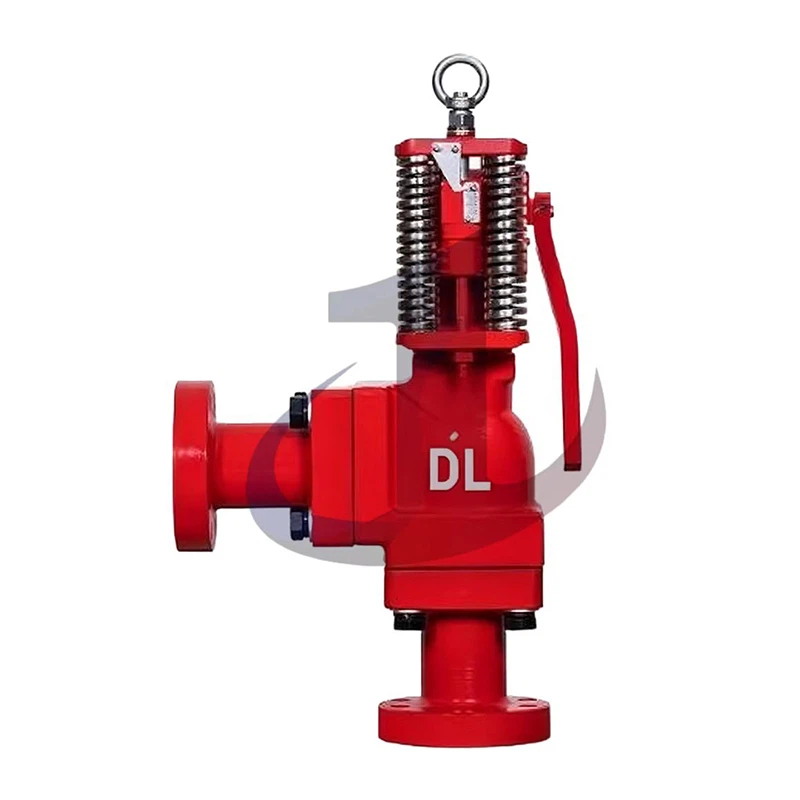


Balanced beam lever advantage: precise triggering through mechanical lever
The trigger mechanism of the Titan C safety valve ingeniously employs the lever principle of a "balance beam", which is an extremely reliable and pure mechanical design. We can think of it as a simple and robust lever system:
Action and Force Arm: Inside the valve, pressure from the pipeline fluid acts on the piston's base, generating an upward thrust. This force travels through a short force arm (short moment arm) to the end of the balance beam. Simultaneously, a strong pre-tensioned helical spring inside the valve cap exerts a constant downward pressure through a longer force arm (long moment arm), acting on the opposite end of the balance beam.
Torque Balance and Unbalance: Under normal operating pressure, the spring torque significantly exceeds the fluid pressure torque. This lever system maintains stability, keeping the internal linkage mechanism in a secure "over-center" locked position that firmly presses the piston against the valve seat for reliable sealing. When system pressure surpasses the preset threshold, the thrust force acting on the piston increases dramatically, causing the generated torque to rise rapidly. Once the fluid pressure torque exceeds the spring's preset torque, the balance is instantly disrupted.
Instantaneous opening: The imbalance of the lever causes the internal connecting rod mechanism to "unlock" and quickly flip past the center point, completely releasing the constraint on the piston. The piston is pushed upward by the huge fluid pressure with almost no delay, instantly opening the pressure relief channel.
Patented hydraulic cushioning technology: the key to prolonging service life
Hydraulic buffer system:
Pressure balancing chamber: The valve is designed with a unique "pressure balancing chamber" inside. As the piston moves upward, the fluid in this chamber is compressed.
Throttling discharge: The piston is processed with a special size of flow guide hole. When the piston moves upward at high speed, the fluid in the pressure balance chamber is forced through these flow guide holes and throttled to the outlet end of the valve.
Hydraulic damping effect: The throttling effect of fluid passing through a orifice generates a hydraulic damping force that opposes the piston's movement. This force is proportional to the piston's speed, enabling smooth and effective deceleration before reaching the end of its stroke. This ensures the piston stops softly rather than slamming into the valve body.
This clever hydraulic cushioning design converts the kinetic energy of the piston into the heat energy dissipated by the fluid, resulting in multiple significant operational benefits:
Extend the life of the seal: by eliminating the violent impact and rebound of the piston, the seal is free from mechanical impact and compression deformation, and its service life is greatly extended.
Improved internal component durability: The entire internal linkage mechanism, including the pin and connecting rod, is effectively protected from high impact loads. This allows the valve to withstand more pressure relief cycles without maintenance, directly improving its reliability.
Ensure stable pressure relief process: Hydraulic buffer completely eliminates the risk of accidental recoil of piston during high flow discharge, and ensures that the pressure relief channel remains completely open throughout the overpressure event.
Fast and reliable reset and manual control
After an overpressure event, it is critical to restore the system to normal operation as quickly as possible. The Titan C type safety valve is also designed to reflect a deep understanding of operational efficiency in this phase.
Manual Tool-Free Reset: The valve features a simple yet durable manual reset handle. By simply pulling the handle upward, the internal linkage mechanism locks into its "over-center" position, instantly closing the valve. This quick reset process takes just seconds and requires no specialized tools.
Trip-Free Safety Design: The reset handle features a trip-free mechanism, meaning that even if the operator forcibly pulls the handle while the system remains over-pressurized, it cannot force the valve to open or close. This design ensures that the safety pressure relief function maintains its highest priority in all scenarios.
Breaking the Sealing Pin Cycle: Unlike conventional safety valves that rely on disposable sealing pins, Titan C's fully mechanical reset mechanism is designed for repeated use. These pins, which are typically replaced after each activation, not only increase spare parts inventory and maintenance costs but also pose reliability risks due to their susceptibility to material batch variations and environmental temperature fluctuations affecting shear strength precision. Titan C's innovative design completely eliminates these issues through its durable, repeatable mechanism.
Clear status indication: There is a "position release button" on the valve cap, and its physical position can visually and clearly show whether the valve is open or closed 3. This function is very important for field personnel to quickly diagnose faults and confirm safety.
Pressure-Regulating Function: In specific operational scenarios, dynamically adjusting the system's maximum pressure limit may be required. The Titan C safety valve enables operators to increase the pressure relief setting by rotating the adjustment nut at the top while the system remains pressurized. This feature provides exceptional operational flexibility, eliminating costly shutdowns that would otherwise be necessary for pressure adjustments.
Forging for extreme conditions: manufacturing processes and materials science
Superior forging process
As the core component that bears all the pressure of the system, the manufacturing process directly determines the final safety grade and service life of the valve. Titan C type safety valve adopts advanced closed forging process instead of traditional casting process for its valve body.
Forging Process: The process begins by heating high-grade solid steel billets to a temperature with good plasticity (typically between 1,050°C and 1,250°C), though still far below their melting point. The molten steel is then placed into precision molds matching the valve's final shape. Using heavy-duty hydraulic presses or mechanical presses, immense pressure is applied to cause plastic deformation in the solid state, ultimately filling the entire mold cavity.
Specifications for advanced materials to cope with harsh environments
The internal components of the Titan C safety valve are also selected to follow the highest standards, using an optimized combination of specialty materials for the function and environment of different components.
3.2.1 Valve body insert: 718 type nickel base alloy (Inconel 718)
The most critical and vulnerable components to fluid erosion and corrosion within a valve are its body inserts. The Titan C variant incorporates Inconel 718-a superalloy-grade nickel-based alloy (commonly known as Inconel 718)-here, embodying its design philosophy for extreme operating conditions. This aerospace-grade material was selected due to its exceptional performance in the following key aspects:
Excellence in Corrosion Resistance: Inconel 718 contains substantial amounts of nickel and chromium, which grants it exceptional resistance to various corrosive agents. It effectively resists corrosion from hydrogen sulfide (H2S)-containing acidic gases (commonly referred to as "acid gas"), carbon dioxide (CO2), high concentrations of chloride ions, and other chemical additives in drilling fluids. This makes the Titan C safety valve fully compliant with industry standards.
The MR0175 standard is designed for the most demanding acid gas field environments.
Excellent high temperature strength: Unlike ordinary stainless steel, which is significantly reduced in strength at high temperatures, Inconel 718 can maintain high strength and creep resistance at temperatures up to 700°C through aging hardening.
The perfect combination of high strength and high toughness: Inconel 718 can achieve extremely high yield strength (the minimum yield strength required by API 6A CRA standard is 120 ksi) after heat treatment, while still maintaining good plasticity and toughness, able to withstand huge impact load without fracture.
Piston and internal connecting rod mechanism
The piston and internal connecting rod mechanism are critical for transmitting force and achieving valve operation. These components must withstand significant mechanical stress and repetitive motion. Therefore, they are typically made from high-strength precipitation-hardened 17-4 PH stainless steel.
Innovative sealing technology
Advanced sealing materials: Hydrogenated Nitrile Butadiene Rubber (HNBR) is a preferred choice. Compared to conventional nitrile rubber (Nitrile), HNBR demonstrates significantly enhanced high-temperature resistance and chemical resistance after hydrogenation treatment, particularly against acidic gases like H₂S and amine-based corrosion inhibitors. In specific high-concentration acid gas environments, HNBR outperforms fluororubber (Viton) in certain applications.
Innovative Structural Design: More crucially, the Titan C-type safety valve features a meticulously engineered internal configuration that strategically positions active sealing components outside the main fluid passage. During valve closure, the piston forms a rigid metal seal with the valve seat while the elastomeric seal remains protected. When instant opening occurs, high-pressure, high-speed drilling fluid containing solid particles is safely discharged through the main passage without directly eroding the delicate elastomeric seals.
The following table summarizes the core technical specifications of Titan C and its high-pressure version Titan CH:
|
parameter |
Titan Class "C" specifications |
Titan CH type (Titan Class "CH") specifications |
|
Product serial number |
Series 34000 |
Series 35000 |
|
Pressure set range (adjustable) |
400 - 1,500 psi 750 - 2,500 psi 1,500 - 5,000 psi |
2,500 - 6,200 psi |
|
operating temperature range |
−20° F to 225° F (−29° C to 107° C) |
−20° F to 225° F (−29° C to 107° C) |
|
Applicable working condition type |
Standard working conditions Acid gas working conditions (in accordance with NACE MR0175 standard) |
Standard working conditions Acid gas working conditions (in accordance with NACE MR0175 standard) |
|
In/Export diameter |
3 inches |
3 inches |
|
Connect mode options |
Flange connections (left-hand joints, e.g. Fig. 602,1002,1502) |
Flange connection (downdrivable welding reserved) by壬 connection (e.g., Fig. 1502) |
|
Key certification |
ISO 9001:2000 DNV type certification ABS type certification (for offshore platforms) |
ISO 9001:2000 DNV type certification |
|
patent |
Hydraulic buffer system (U.S. Patent 5,715,861) |
Hydraulic buffer system (U.S. Patent 5,715,861) |
The value and significance of certification
Each certification represents an authoritative recognition of the performance, quality and safety of Titan C type safety valves in a specific field, which has important practical implications for customers:
ISO 9001 Quality Management System Certification: This globally recognized standard demonstrates that NOV has followed a rigorous, traceable and continuous improvement quality management system throughout the design, manufacture and testing of Titan C safety valves. This provides a foundation for product quality consistency and reliability.
Core protection of drilling fluid circulation system
This represents the most fundamental and critical application of Titan C-type safety valves. Typically installed on mud pump discharge lines or high-pressure manifold systems, they serve as the final safeguard for the entire drilling fluid circulation system. During drilling operations, complex downhole conditions (such as wellbore collapse or drill bit blockage) may cause temporary pressure buildup in circulation pipelines, generating destructive pressure spikes. The Titan C-type safety valve activates instantaneously when pressure reaches preset thresholds, safely releasing high-pressure mud back into the storage tank. This mechanism provides protection for:
Mud pump: Avoid damage to the pump's core components such as cylinder, cylinder sleeve and piston caused by overpressure, which are costly and time-consuming to repair or replace.
High pressure pipe and pipeline: Prevent the rupture of pressure equipment such as pipe, valves and high pressure hose due to exceeding their rated pressure, avoid mud leakage and potential environmental and safety accidents.
Downstream equipment: Protect downhole measurement instruments (MWD/LWD) and drill string assembly from extreme pressure impacts.
Empowering advanced drilling technologies
With the development of oil and gas exploration to deep water, ultra-deep water and complex geological structures, the traditional drilling methods are facing great challenges. The emergence of advanced technologies such as managed pressure drilling (MPD) has put forward unprecedented requirements for the precision and reliability of pressure control.
Managed Pressure Drilling (MPD): The core of MPD technology lies in drilling within an extremely narrow "pressure window," where bottomhole pressure must be precisely controlled between formation pressure and fracture pressure. In this delicate operation, any deviation in pressure control can lead to complex situations like kicks or blowouts. The Titan C Safety Valve plays a critical role here. With its vibration-insensitive setpoint and rapid response capability, it provides reliable upper pressure protection for MPD systems. This allows operators to drill with greater confidence under parameters approaching operational limits, thereby improving drilling speed (ROP), effectively managing wellbore stability, and safely reaching formations within the narrow pressure window. In MPD operations, the reliability of the safety valve directly determines the success of the entire drilling strategy.
Unbalanced Borehole Drilling (UBD) and Closed-Loop Drilling: As critical safety components in these technologies that require active management of wellbore annular pressure, Titan C-type safety valves ensure system pressure remains securely within design parameters when surface equipment (e.g., rotary control head RCD, choke manifold) malfunctions or operational errors occur.
Production increase and well repair of wellbore
In addition to drilling operations, Titan C safety valves also play a key role in high pressure, high displacement well production and well repair operations.
Hydraulic Fracturing: Modern fracturing operations require pumping large volumes of fracturing fluid and proppant into underground reservoirs under extreme pressure and flow rates. The fracturing truck units and surface high-pressure pipelines ("steel pipelines") endure tremendous stress. Titan C safety valves are employed to protect these expensive fracturing systems, preventing overpressure incidents caused by sudden downhole pressure fluctuations or equipment malfunctions, thereby ensuring the safety and continuity of large-scale fracturing operations. Their robust construction and erosion-resistant design enable effective handling of solid proppant particles contained in fracturing fluids.
Cementing and Acidizing: High-pressure pumps are essential equipment in cementing and acidizing operations. The Titan C safety valve provides reliable overpressure protection for pumping equipment and surface pipelines in these processes, ensuring safe and smooth completion of wellbore integrity operations.
For equipment upgrades or replacements, ease of integration and long-term economy are key considerations.
The convenience of direct interchangeability: This represents a critical business advantage. The NOV Titan C safety valve is specifically designed to accommodate existing market equipment, with installation dimensions and interface specifications that enable seamless replacement with widely used Cameron and Retsco C-type valves. This means customers can upgrade their aging, unreliable safety valves without modifying existing pipelines, achieving true plug-and-play replacement. This significantly reduces the costs, time, and technical barriers associated with equipment upgrades.
Excellence in Total Life Cycle Value: The Titan C safety valve delivers value that surpasses its initial purchase price. This investment ensures long-term returns by reducing unplanned downtime, lowering maintenance and spare parts costs, and preventing catastrophic equipment failures caused by overpressure. Its total cost of ownership (TCO) is significantly lower than conventional alternatives, making it the most cost-effective premium safety valve solution available.
Hot Tags: dl sentinel type c reset safety valve, China dl sentinel type c reset safety valve manufacturers, suppliers, factory


