

Excellent material and precision workmanship
Valve body -- an indestructible foundation of strength
Material Selection: The valve body is manufactured from high-strength low-alloy steel, typically grade AISI 4130 (chromoly steel). This material is renowned for its exceptional mechanical properties, including a tensile strength of up to 560 MPa and yield strength of 460 MPa. Its outstanding toughness and fatigue resistance enable it to handle working pressures as high as 5,000 PSI (345 Bar) or even higher.
Manufacturing Process: The valve body is manufactured through integral forging. Compared to casting techniques, forging refines and homogenizes metal grains internally while eliminating potential internal defects such as porosity and voids. This process enhances structural integrity and pressure-bearing capacity, fundamentally eliminating safety hazards caused by material imperfections.
The core of hydraulic piston -- performance and corrosion resistance
Material selection: The piston is made of high-grade stainless steel. In high-performance models and interchangeable products, it is specified to use 17-4 PH (UNS S17400) precipitation hardened stainless steel.
Heat Treatment Processes and Compliance: Heat treatment is crucial for unlocking the 17-4 PH potential. In acidic environments containing hydrogen sulfide (H₂S), material selection and processing must strictly adhere to NACE MR0175 standards to prevent sulfide stress cracking (SSC) – a critical failure mode that demands rigorous control.
Sealing system -- designed for long life and chemical compatibility
The reliability of sealing system directly determines the service life and maintenance cost of valve.
Design concept: The main elastomer seal is cleverly designed outside the mainstream channel, minimizing direct contact with high flow rate and high abrasion of drilling fluid, which is the core design concept to extend the sealing life.
Material Options: NOV offers multiple elastomer options for different drilling fluid systems. The standard configuration may use NBR (Nitrile Rubber), which provides excellent oil resistance. However, to address the high temperatures and chemical additives in modern complex drilling fluid systems, HNBR (Hydrotreated Nitrile Rubber) has become a superior choice. Compared to NBR, HNBR demonstrates a wider temperature tolerance (up to 160°C), enhanced wear resistance, and superior corrosion resistance against harsh media including winter diesel-based mud, acids, alkalis, and various chemical treatments. This ensures longer seal life and reduced maintenance requirements.
Valve cover assembly -- full protection, lifetime lubrication
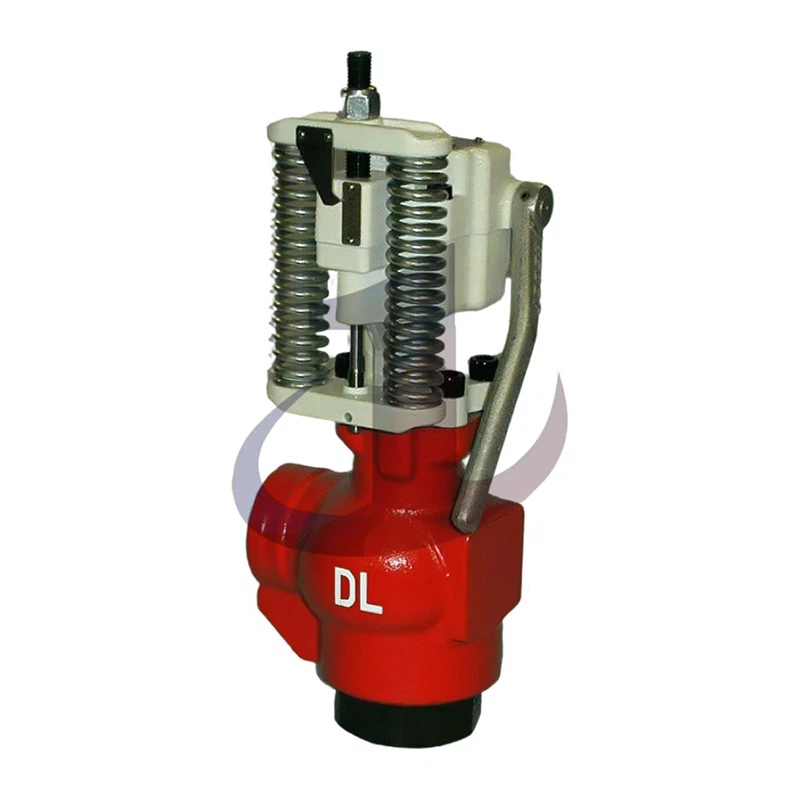
Valve cover assembly is the heart of the whole valve mechanical movement, its internal integration of crank, connecting rod, spring and other precision transmission parts.
Enclosed design: the whole valve cover assembly adopts the enclosed design, like a strong fortress, completely isolates all the internal precision moving parts from the dust, mud, salt spray and other pollutants commonly used in the drilling site, ensuring the smooth and reliable movement of the mechanism.
Internal lubrication: The valve cover is pre-filled with high-performance grease. This not only ensures that the reset mechanism maintains low friction and smooth operation without sticking during thousands of cycles, but also provides a lasting corrosion protection for all internal metal parts, achieving a truly long-term maintenance-free period.
The following table summarizes the material specifications of key components of NOV Type B safety valve and their engineering advantages.
Table 1: Material specifications and characteristics of key components
|
component |
Standard working condition material |
Acid gas (H2S) working condition material (in accordance with NACE MR0175) |
Engineering advantages |
|
valve body |
Forging low alloy steel (e.g. AISI 4130) |
Forged low alloy steel (e.g. AISI 4130), hardness controlled (≤22HRC) |
With high tensile strength, toughness and fatigue resistance, it can safely carry high pressure. The forging process ensures excellent structural integrity. |
|
plunger |
Stainless steel (17-4 PH, H900/H1025 status) |
Stainless steel (17-4 PH, H1150-D state, ≤33HRC) |
The perfect combination of high strength to resist deformation and excellent corrosion resistance. The H1150-D state provides a critical ability to combat sulfide stress cracking. |
|
seal components |
NBR (butadiene-nitrile rubber) elastomer |
HNBR (hydrogenated nitrile rubber) or other special elastomers |
NBR provides good oil resistance. HNBR provides superior performance for high temperature, wear and corrosion resistant drilling fluid chemicals, thus extending service life. |
|
bonnet |
carbon steel |
Carbon steel, with anti-corrosion coating (e.g. cadmium/Gullite) |
The fully enclosed design protects the internal structure. In harsh Marine environments, the coating enhances corrosion resistance. |
Performance parameters and technical specifications
Table 2: NOV Type B 3 inch model technical specifications
|
parameter |
specifications |
|
model |
Type B manual reset safety valve |
|
size |
3 inches |
|
Port connections |
3" API pipeline with internal thread (female threaded) |
|
maximum working pressure |
5,000 PSI (345 Bar) |
|
Adjustable pressure range |
• 400 – 1,500 PSI (28 – 103 Bar) • 750 – 2,500 PSI (52 – 172 Bar) • 1,500 – 5,000 PSI (103 – 345 Bar) |
|
Applicable working condition type |
Standard conditions, acid gas (H2S) conditions (in accordance with NACE MR0175) |
|
Pressure setting scale |
PSI, Bar, MPa |
Table 3: Competitive advantage analysis: NOV Type B manual reset valve vs. traditional pin safety valve
|
Characteristics/ Indicators |
NOV Type B manual reset safety valve |
Traditional shear type safety valve |
|
Repositioning time and procedure |
In seconds. The operator only needs to pull a single external handle. |
30 minutes to several hours. Need to stop the pump, relieve pressure, and enter the site manually to replace the pin. |
|
Impact on non-production time (NPT) |
Impact is minimal. The system can be reset almost immediately and restored to online status. |
The impact is huge. Each activation event results in a costly period of non-production time. |
|
Personnel safety |
High. All moving parts are completely enclosed. No projectiles are ejected when activated. |
Medium to low. When activated, a cut pin fragment may be ejected, posing a risk of projectile injury. |
|
Reliability and set point accuracy |
High. The set point remains stable regardless of vibration and pressure fluctuations. |
Low. It is easy to cause "miscutting" due to vibration, or fail to cut under the correct pressure due to fatigue of the pin. |
|
Total cost of ownership (TCO) |
Lower. The higher initial investment pays off quickly by dramatically reducing NPT and improving reliability. |
Higher. Lower initial procurement costs can be deceptive; repeated downtime, labor costs and spare parts inventory drive up the TCO. |

Hot Tags: dl sentinel type b 3 inch reset safety valve, China dl sentinel type b 3 inch reset safety valve manufacturers, suppliers, factory