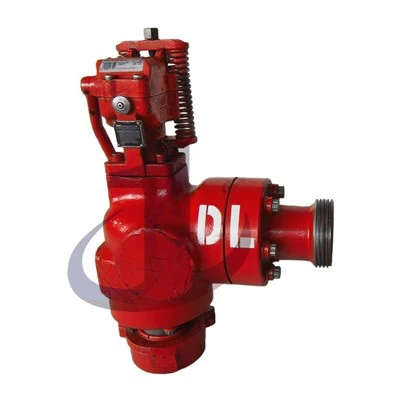
"Instant full open" pressure relief action
The core safety feature of this valve lies in its unique "Snap-to-Open" pressure relief mechanism. When system pipeline pressure exceeds the preset safety threshold, the valve's precision mechanical structure activates instantly, enabling the valve to "automatically and rapidly expand to full opening position". This critical action ensures the pressure relief channel achieves maximum flow area in the shortest time, allowing high-pressure fluid to discharge unimpeded. Unlike some slow-opening or proportional-opening control valves, OTECO's instant full-open design effectively addresses sudden pressure spikes caused by downstream blockages. This innovative design resolves crises within milliseconds, preventing irreversible permanent damage to hydraulic components of mud pumps or high-pressure pipeline assemblies.
Manual control and reset function
The "RR" type safety valve features dual operation modes, significantly enhancing operational flexibility and controllability in field applications. Beyond automatic pressure relief functionality, field operators can instantly open the valve by pressing the manual release button. This manual activation feature proves invaluable in various scenarios-such as system maintenance, pipeline testing, or scheduled pressure relief operations-allowing operators to control depressurization without adjusting pressure settings. The manual reset mechanism is equally critical: when overpressure events occur and system pressure returns to normal, operators simply need to manually reset the lever to return the valve to standby closed position. Compared to traditional safety valves requiring equipment shutdown for clip replacement or other wear-prone parts, this design dramatically reduces recovery time and directly lowers costly non-production time (NPT).
Visual status indicator
In drilling platforms where high-decibel noise and complex environments prevail, clear and unambiguous information transmission is fundamental to safety. The OTECO Type "RR" safety valve addresses this critical need through its release button design that provides a "clear visual indicator of valve status". When the valve is open for pressure relief, the release button shifts to a distinct position, offering immediate visual confirmation. This design demonstrates profound ergonomic insights for high-risk environments. By simplifying complex equipment status into intuitive visual signals, it reduces cognitive load and decision-making pressure during emergencies, thereby minimizing operational errors caused by misjudgment. Though seemingly minor, this design plays a vital role in enhancing overall safety standards.
Pressure setting mechanism
The pressure setting mechanism of this valve is engineered for both precision and user-friendliness. By simply turning the adjustment nut at the valve's top, operators can precisely adjust the pressure relief value across its full operational range, with the current setting displayed through a clear indicator. This design enables field technicians to quickly and accurately calibrate the pressure settings according to varying operational conditions-such as different well depths, geological formations, or mud density. Crucially, the valve's pressure setting mechanism demonstrates exceptional stability, with "setpoints remaining unaffected by valve operation or (drilling rig) vibrations." Given the persistent mechanical vibrations during drilling operations, this feature ensures the safety valve's pressure relief setting remains constant and reliable throughout the entire work cycle, effectively preventing safety hazards caused by vibration-induced drift in setpoints.
Pressure performance: engineering technical specifications and service levels
This section will present the core technical data of OTECO 3-inch Type "RR" 7500 PSI safety valve in a clear and standardized format, providing an authoritative reference for engineers to select, purchasers to compare, and technical specification writers.
Table 1: OTECO 3 inch Type "RR" 7500PSI Key Performance Specifications
|
parameter |
specifications |
|
model |
3 inch Type "RR" manual reset safety valve |
|
maximum normal working pressure |
7500 PSI (some designs up to 8000 PSI, reflecting sufficient design margins) |
|
Adjustable pressure range |
3,000 PSI to 8,000 PSI (206 Bar to 552 Bar) |
|
Import/export connection form |
3-inch Figure 1502 FMC Weco® by壬 connection (provides multiple configurations such as male inlet/outlet) |
|
Rated operating temperature range |
−20° F to 250° F (−29° C to 121° C) |
|
Optional service types |
Standard working condition service (Standard Service); sour gas H₂S service (Sour Gas H₂S Service) |
|
Main industry certifications |
DNV type certification (6 models approved in the same series); ABS design evaluation (12 models approved in the same series) |
|
Lumen area |
Approximately 4.9 in2 (31.6 cm2) (Refer to the data of the 8000 PSI model in the same class) |
|
Valve weight (approx.) |
Approximately 325 lbs (147.4 kg) (Refer to data for the 8000 PSI model in the same class) |
OTECO manufactures: From advanced metallurgy to sub-micron precision machining
Advantages of precision casting
The key complex components of the valve, such as the bonnet, are manufactured using the advanced investment casting process, commonly known as the "lost-wax method". Compared with traditional sand casting, investment casting has overwhelming advantages in multiple dimensions:
Precision in dimensional control: Investment casting achieves exceptional dimensional tolerances (typically CT4-CT7 grades under ISO 8062 standards), with linear tolerances maintained at ±0.003 inches per inch. This enables castings to closely match final design specifications, achieving near-net forming that significantly reduces or even eliminates the need for secondary machining processes.
Surface finish: This process produces castings with exceptionally smooth surfaces, typically achieving a surface roughness (Ra) value between 63-125 microns (1.6-3.2 μm). In contrast, sand-cast surfaces exhibit significantly higher roughness (Ra 250-500 microns). The superior surface finish is crucial for ensuring airtight sealing of the mating surfaces and minimizing turbulence during fluid flow.
Structural Integrity and Complexity: Investment casting enables the production of integral components with intricate internal structures, thin walls, and no parting lines. This not only enhances structural strength and uniformity but also allows designers to achieve optimized gate systems. This fundamental principle of "improved precision and repeatability" is consistently highlighted in OTECO's product documentation.
Processing accuracy: Application of high precision horizontal machining center (HMC)
Building on the precision casting, OTECO uses a "single clamp, high-precision horizontal machining center (HMC)" for the final finishing of key dimensions. This choice reflects an uncompromising pursuit of machining accuracy.
The significance of "single setup": Horizontal Milling Centers (HMCs) enable simultaneous machining of multiple workpiece surfaces (e.g., valve body flange surfaces, piston chamber bores, sealing grooves) through their multi-axis coordination and rotary tables in a single setup. Traditional machining methods often require repeated disassembly and re-establishment of workpiece setups, with each setup process introducing minor positional deviations.
The process advantages of HMC: The horizontal spindle configuration of the lathe allows metal chips to naturally fall under gravity during machining, achieving exceptional chip removal efficiency. This not only prevents chip scratches on processed surfaces and ensures superior surface quality, but also reduces tool wear, thereby enhancing machining precision and consistency.
Advanced materials and surface engineering technology
The durability of the OTECO Type "RR" safety valve is achieved through a multi-layered material and surface treatment defense system.
High performance surface coating:
Xylan® Internal Coating: All valve surfaces in contact with fluids undergo Xylan coating treatment to "enhance corrosion resistance and extend service life". Xylan is a fluoropolymer coating primarily composed of polytetrafluoroethylene (PTFE), which forms a protective film on metal surfaces with chemical inertness, low friction coefficient, and non-stick properties. Under the abrasive scouring of highly erosive drilling mud, the Xylan coating effectively prevents mud particle adhesion and erosion on valve inner walls, ensuring smooth piston movement and avoiding jamming.
Gullite™ Coating: Critical moving components such as valve cover assemblies and pistons utilize the "Gullite coating" technology. This advanced coating delivers exceptional hardness, superior wear resistance, outstanding corrosion resistance, and self-lubricating properties. The Gullite coating ensures that pistons and reset mechanisms maintain smooth operation through thousands of high-pressure cycles, remaining free from wear, scratches, or rust.
Sealing technology for different operating conditions: OTECO provides a variety of sealing materials for standard and harsh sulfur-containing operating conditions to ensure reliable sealing in any chemical environment.
Table 2: Comparison of material specifications between standard working condition and hydrogen sulfide (H₂S) working condition
|
component |
Standard working condition materials |
Materials containing hydrogen sulfide (H₂S) |
Reasons for selecting H₂S working condition materials |
|
Master seal |
Polyethylene (Polyethylene) / Fluoropolymer (Fluoropolymer) |
TFM (modified PTFE)/ HNBR (hydrogenated nitrile rubber) |
Compared to standard nitrile rubber (NBR), HBR is more resistant to material embrittlement caused by H₂S and rapid gas reduction (RGD) effects. TFM provides superior chemical corrosion resistance. |
|
plunger |
Stainless Steel (Stainless Steel) |
Anti-sulfur grade stainless steel (Sour Gas Grade Stainless Steel) |
The content of alloying elements such as chromium and molybdenum was increased to resist sulfide stress corrosion cracking (SSC). |
|
Valve body/joint |
Standard alloy steel |
Alloy steel compliant with NACE MR0175 standard |
By controlling the chemical composition and heat treatment process, ensure that the material hardness (typically ≤ 22 HRC) and metallographic structure to prevent hydrogen cracking (HIC) and hydrogen embrittlement. |
|
O molding ring |
NBR (butadiene nitrile rubber) |
HNBR / Viton (FKM, fluororubber) |
Viton and HNBR exhibit excellent chemical resistance and high temperature resistance in sulfur-containing environments. |
application area
The patron saint of the mud circulation system
The primary application of this safety valve is to protect high-pressure mud pumps (typically three-cylinder systems) and mudline manifold assemblies. During drilling operations, high-pressure mud (reaching 7500 PSI) is pumped into the wellbore to perform multiple functions including cooling drill bits, transporting cuttings, and balancing formation pressure. If blockages occur in downhole or surface pipelines, the pump outlet pressure will spike dramatically. The rapid full-flow opening capability of the "RR" type safety valve ensures immediate release of this pressure surge, safeguarding the hydraulic end assembly of the mud pump. As the most expensive and vulnerable component in a mud pump system, any damage to this hydraulic end not only incurs high replacement costs but also leads to prolonged drilling downtime, resulting in significant non-productive time (NPT) losses.
In addition to the drilling mud system, the valve is also widely used in cementing trucks, fracturing fleets' high-pressure pipelines and other high-pressure fluid processing systems that require reliable overpressure protection.
Hot Tags: dl sentinel type rr 3 inch 7500 psl reset safety valve, China dl sentinel type rr 3 inch 7500 psl reset safety valve manufacturers, suppliers, factory