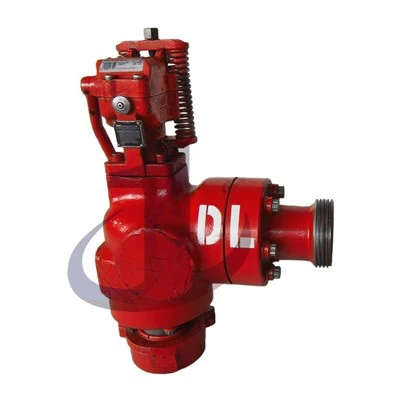
Mechanism core: advanced rapid working principle
The exceptional performance of OTECO's "RR" type safety valve stems from its meticulously engineered internal mechanical structure, which ensures instantaneous, decisive, and full-flow response during overpressure incidents. This distinctive "rapid-acting" feature stands as the key differentiator from traditional pressure relief valves and forms the foundation for its superior equipment protection capabilities.
Detailed explanation of rapid pressure relief principle
The valve's core advantage lies in its ability to "automatically open to full position instantly when preset pressure is exceeded." This functionality is achieved through a precision mechanical linkage and spring-loaded mechanism. Under normal operating pressure, the system remains stable at a "centerline" position, securely pressing the valve piston against the seat to ensure reliable sealing. As system pressure gradually increases to reach the preset critical point, the force applied to the piston becomes sufficient to overcome the spring's preload, pushing the linkage mechanism past a mechanical "over-center" point. Once this critical threshold is crossed, the spring's stored energy is instantly released, driving the linkage mechanism to rapidly pull the piston open – enabling instant valve activation through rapid actuation.
This instantaneous full-opening mechanism delivers two critical advantages: First, it dramatically reduces system exposure to overpressure, rapidly bringing pressure down to safe levels. Second, the fully open configuration allows high-pressure, highly abrasive drilling fluid to flow through the valve with minimal resistance, preventing severe erosion of seals and valve seats caused by high-speed fluid flow during partial opening. This erosion is the primary cause of seal failure in progressive or slow-opening valves, while OTECO's rapid-action design fundamentally resolves this issue.
Operational control and safety features
The design of OTECO Type "RR" valve not only focuses on pressure relief performance, but also integrates a complete set of operational safety logic to ensure that operators have a full control and clear awareness of the system status.
Manual Reset Mechanism: Following a pressure release event, the valve remains fully open until manually reset by an operator using an external reset handle. This critical active safety design requires operators to physically verify the overpressure condition, investigate its root causes, and resolve them before resuming system operation. By eliminating the automatic reset valve's repetitive cycling under sustained overpressure – a process that accelerates wear and may mask deeper system issues – this innovation transforms a simple mechanical component into a programmed safety control integrated into drilling platform protocols.
Manual release function: The valve can be opened instantly and easily by pressing the manual release button regardless of pipeline pressure. This provides operators with a reliable way to actively and quickly relieve pipeline pressure in emergency situations or before system maintenance.
Visual status indication: The release button position provides operators with a "one-glance" visual confirmation, clearly indicating whether the valve is open or closed. This intuitive design greatly enhances the situational awareness of field personnel and reduces the risk of misjudgment.
Pressure setting accuracy and stability
Precise and stable pressure setting is the cornerstone of safety valve reliability. The OTECO Type "RR" valve ensures absolute reliability of pressure setting in harsh drilling environments through its sophisticated design.
The pressure setpoint can be easily adjusted by rotating the regulating nut at the valve's top, with a clear pointer indicating the range across the entire operating range. Crucially, its internal locking and pre-tightening mechanism ensures "setpoints remain unaffected by valve operation vibrations". In the drilling platform's environment filled with intense mechanical vibrations, this vibration-resistant design guarantees preset relief pressure remains stable despite environmental impacts. This prevents accidental triggering or malfunction caused by setpoint deviations, ensuring long-term effectiveness of protective functions.
The cornerstone of excellence: exquisite manufacturing
The exceptional reliability of OTECO's "RR" type safety valves stems from their relentless pursuit of precision in manufacturing. The company employs an advanced "hybrid manufacturing" strategy, carefully selecting the most suitable production techniques for different valve components based on their functional and structural requirements, rather than adopting a one-size-fits-all traditional approach. This meticulous attention to engineering details forms the fundamental guarantee for maintaining outstanding performance under extreme operating conditions.
High precision machining of Horizontal machining center (HMC)
The horizontal machining center (HMC) enables simultaneous machining of multiple surfaces on complex components like valve bodies through a single setup (known as "Single Chucking"). This process offers decisive advantages. Traditional multi-setup machining methods introduce cumulative errors from repeated workpiece positioning and clamping, creating what's known as the "tolerance accumulation" effect. By eliminating such cumulative errors through single-setup operations, HMC ensures exceptional dimensional and geometric precision among valve components. These superior qualities directly translate into the following performance benefits:
Perfect alignment: ensure that the motion trajectory of the internal moving mechanism (such as piston, connecting rod) of the valve is accurate and smooth, and avoid jam or abnormal wear caused by misalignment of components.
Seal integrity: ensures the flatness and smoothness of the sealing surface, so that the sealing can be perfectly bonded with the valve body and piston to achieve zero leakage under high pressure.
Absolute repeatability: Ensure that each valve delivered has exactly the same performance parameters, providing users with a consistent quality assurance.
The balance between strength and complexity brought by investment casting
The valve cover (Bonnet), serving as the core component that houses and supports the entire complex rapid-action mechanism, requires meticulous selection of manufacturing processes. OTECO employs "lost-wax casting" for its valve covers and components. This precision casting technique offers distinct advantages over traditional sand casting:
Complex geometry implementation capability: The ability to manufacture the complex internal cavities and fine structures required by the linkage mechanism in the valve cover, which is difficult to achieve by other casting methods.
Excellent surface finish: The surface of a lost-wax casting is very smooth, usually achieving 125 RMS or better finish, which greatly reduces or eliminates the need for secondary machining, ensuring smooth internal channels and low friction running of moving parts.
Dense structure: The cast structure is dense and uniform, with almost no internal defects such as looseness and porosity commonly found in sand casting, thus obtaining higher strength and anti-fatigue performance, ensuring "higher precision and repeatability".
Forging ultimate structural integrity of valve body
Superior mechanical strength: the tensile strength, impact toughness and fatigue strength of forgings are much higher than that of castings.
No internal defects: the forging process can eliminate the possible internal defects such as looseness, porosity and inclusions in the casting, ensuring the density and uniformity of the material.
Higher pressure capacity: Forged valves can withstand higher pressures with the same wall thickness, or can be designed to be lighter while meeting the same pressure grade.
Metallurgical process of core components
Piston: The use of stainless steel pistons is crucial for ensuring reliable valve operation. The superior corrosion resistance of stainless steel prevents rust or corrosion from occurring after prolonged contact with drilling fluid, guaranteeing smooth and unobstructed movement within the valve body. This ensures instant response capability even after extended periods of inactivity.
Subs: The valve utilizes a "cadmium-plated joint". Furthermore, the "single-piece joint" design represents a significant engineering improvement. Compared to joints requiring multi-component welding or threaded connections, this integrated construction reduces potential leakage pathways and stress concentration points, thereby substantially enhancing both sealing integrity and structural reliability.
Valve Cover and Internal Components: Some valve cover assemblies and pistons utilize "Gullite coating" treatment, with an "Xylan coating" applied to internal surfaces. These two high-performance coatings are designed to reduce friction between moving parts while providing an additional corrosion and wear-resistant barrier. The low-friction characteristics ensure the quick-action mechanism operates with enhanced sensitivity and smoothness during activation, while the improved corrosion resistance further extends the service life of the entire valve cover assembly.
Advanced sealing solutions for harsh environments
The sealing system is the heart of the safety valve, and its performance directly determines the reliability of the valve. For different working conditions, we provide optimized, multi-level sealing material solutions.
Standard Service Configuration: The standard configuration utilizes nitrile rubber (NBR) as the cushion ring and employs a material called "TVR" for the outer seal. NBR, an elastomer with excellent balanced performance and superior oil resistance, is ideal for conventional water-based or oil-based drilling fluid environments. As OTECO's proprietary material grade, TVR likely features specially formulated enhancements to deliver exceptional wear resistance, specifically designed to withstand high-speed erosion from solid particles in drilling fluids.
Sour Gas H₂S Service: In extreme corrosive environments containing hydrogen sulfide (H₂S), the material configuration undergoes a comprehensive upgrade. The buffer ring is upgraded to hydrogenated nitrile rubber (HNBR), while the main seal adopts TFM material.
HNBR: Compared with standard NBR, HNBR has better chemical resistance, higher temperature resistance and excellent resistance to H₂S corrosion and "hydrogen sulfide" embrittlement, making it an ideal elastomer choice for acid service environments.
TFM: This modified polytetrafluoroethylene (Modified PTFE) represents the cutting edge of sealing material technology. In high-pressure safety valves where seals endure prolonged exposure to extreme preload and medium pressure, the choice of TFM over standard PTFE demonstrates OTECO engineers' profound understanding and foresight regarding potential failure modes in conventional materials. By adopting a more advanced material with superior performance and higher costs, they ensure long-term sealing reliability under the most hazardous operating conditions.
Sealing Design Philosophy: A pivotal innovation lies in positioning the sealing element "outside the fluid flow path". During rapid valve actuation, the piston swiftly disengages the seal from the discharge channel, protecting it from direct erosion by high-velocity, abrasive drilling fluids. This "rapid-sealing mechanism" fundamentally extends component durability, serving as a cornerstone for the valve's long-term maintenance-free operation and exceptional reliability.
Table 1: Material and Seal selection guide
In order to help users choose the most appropriate valve configuration according to the specific operating environment, the following table clearly summarizes the key component material differences and their performance advantages under standard working conditions and acid gas working conditions.
|
component |
Standard working condition materials |
Performance advantage |
Acid gas (H₂S) working condition materials |
Performance advantage |
|
plunger |
stainless steel |
Corrosion resistant, wear resistant |
Anti-H₂S stainless steel |
Enhanced resistance to sulfide stress cracking |
|
connect |
cadmium-plated steel |
General corrosion resistance |
cadmium-plated steel |
General corrosion resistance |
|
buffering ring |
Dinitrile rubber (NBR) |
Good oil/mud resistance |
Hydrotreated nitrile rubber (HNBR) |
Excellent resistance to H₂S, heat and chemical |
|
primary seal |
TVR (proprietary elastomer) |
high-wearing feature |
TFM (modified PTFE) |
Extreme chemical inertness, low cold flow |
|
Internal coating |
standard |
not applicable |
Xylan |
Low friction, enhanced corrosion barrier |
Comprehensive performance data
Pressure and temperature grades:
Working pressure range: The valve is designed to operate in a working pressure range of 400 to 5,000 PSI, corresponding to 28 to 350 Bar in metric units. This wide range allows it to accommodate a variety of drilling and completion operations from low to high pressure.
Working temperature range: The standard model operates in a temperature range of-20 ° F to 250 ° F, or-29 ° C to 121 ° C. This temperature range covers the vast majority of onshore and offshore drilling operations.
Flow and size data:
Flow area: The effective flow area of the valve in full open state is 1.8 inch2 (square inches), equivalent to 11.6 cm2 (square centimeters). The sufficient flow area ensures that a large amount of fluid can be discharged quickly and efficiently during pressure relief, and the system pressure can be reduced quickly.
Weight: The weight of the valve varies depending on the connection. For example, a model with a 2-inch LPT (pipe thread) connection weighs about 50 pounds (22.6 kg), while a model with a 2-inch Fig 1502 nunch connection weighs about 56 pounds (25.4 kg).
Set precision:
The OTECO "RR" type safety valve achieves a set pressure accuracy of up to ±5%. This critical performance metric ensures minimal deviation between the valve's actual opening pressure and its preset value. In contrast, traditional pin-type safety valves (PRVs) typically have an accuracy range of
±10% of the level. Higher accuracy ensures that the equipment can be protected when it is closer to its design limit pressure, which avoids production interruption caused by premature pressure release and eliminates the risk of equipment damage caused by delayed pressure release.
Table 2: OTECO 2 "Type" RR" Technical specifications list
The following table provides a clear and comprehensive overview of the core technical parameters of the valve, which is an authoritative reference for engineering design and equipment procurement.
|
parameter |
Numerical (in metric) |
Numerical (metric) |
|
working range |
|
|
|
pressure limit |
400 - 5,000 PSI |
28 - 350 Bar |
|
temperature range |
−20∘F to 250∘F |
−29∘C to 121∘C |
|
Setting point accuracy |
±5% |
±5% |
|
Physical dimensions |
|
|
|
inside nominal diameter |
2 inch |
DN 50 |
|
circulation area |
1.8 in2 |
11.6 cm2 |
|
Connection and weight |
|
|
|
2" LPT |
50 lbs |
22.6 kg |
|
2" Fig 1502 Weco |
56 lbs |
25.4 kg |
|
2.06" -5,000# RJ flange |
(Depending on specific specifications) |
(Depending on specific specifications) |
|
Type of condition |
Standard working conditions & Acid gas (H₂S) |
Standard working conditions & Acid gas (H₂S) |
Flexible and diverse connection configurations
To maximize valve adaptability and ease of installation, OTECO offers a range of industry-standard end connections. This design strategy enables Type "RR" valves to serve as plug-and-play solutions, allowing seamless integration into nearly all existing or new drilling systems without requiring costly and complex pipeline modifications.
The standard connection methods provided include:
Line Pipe Thread (LPT): A universal and economical thread connection for a variety of medium and low voltage applications.
FMC Weco Hammer Union: For example, the commonly used Figure 1502 model is a quick-connect/disconnect union widely used in high-pressure, temporary pipeline connections, especially suitable for frequent disassembly and installation on drilling sites.
API Flanged (API Flanged): For example, the 2.06" -5,000# RJ flange is a high-pressure flange connection that complies with the American Petroleum Institute (API) standard, providing maximum connection strength and seal reliability, and is the preferred choice for permanent high-pressure pipeline installations.
Hot Tags: dl sentinel type rr 2 inch reset safety valve, China dl sentinel type rr 2 inch reset safety valve manufacturers, suppliers, factory