Analysis of Powertrain Architecture and Mechanical Engineering
Rack Structure and Material Mechanics
- The PZ-11's design philosophy emphasizes the balance between high strength and lightweight. Unlike traditional welded steel plate frames, it features a **nodular iron** cast frame.
- Material Advantages: Ductile iron maintains strength comparable to cast steel while delivering exceptional vibration damping. When operating at full load (1600 HP to 2000 HP), the pump body generates complex vibration spectra. The graphite morphology in ductile iron effectively absorbs high-frequency vibrations, preventing stress concentration-induced fatigue cracks-a critical feature for structural components subjected to prolonged alternating loads.
Weight data: This design makes PZ-11 lighter than other pumps in the same class.
The dry weight of the pump body (excluding the base) is approximately 37,000 pounds (16,783 kg).
The total weight of the large steel base is approximately 41,400 pounds (18,779 kg).
Engineering Insight: Compared with the same class of welding frame pump, the weight reduction of about 25% means the reduction of the relocation cost of the drilling rig, which is of significant economic benefit especially in the case of frequent movement of cluster well operation.
Kinematic characteristics of the transmission chain
The core of the transmission system is to convert rotational torque into a powerful connecting rod thrust. The transmission design parameters of the PZ-11 are as follows:
- Rated input power: 1,600 BHP (1,193 kW).
- Rated stroke rate: 115 strokes per minute (SPM).
- Stroke length: 11 inches (279 mm).
Design considerations: The 11-inch stroke belongs to the medium-short stroke design. Compared with the long stroke pump of 14-inch or 16-inch, the short stroke design makes the pump body more compact, and the piston linear velocity is moderate under the same displacement demand, which is conducive to prolonging the service life of the cylinder liner and piston, and reducing the fluid pulsation.
- Gear ratio: 4.38:1.
This speed ratio is optimized for standard drilling motors (rated at approximately 1000-1200 RPM). Featuring a **double helix (herringbone) gear design**, the gear is forged from high-strength alloy steel (e.g., ANSI 4340) and heat-treated. The helical structure automatically counteracts axial thrust, ensuring smooth operation with low noise. Its large tooth contact area enables exceptional torque impact resistance.
- Maximum Rod Load:
PZ-11:150,300 pounds (68,175 kg).
PX-11:186,875 pounds (84,765 kg).
Key difference: This is the fundamental distinction between the PZ-11 and PX-11. The PX-11 enhances the load-bearing capacity of its connecting rod by approximately 24% through reinforced materials for the bearings, crankshaft, and connecting rod. This allows the PX-11 to either withstand higher exhaust pressure with the same cylinder liner size or utilize a larger cylinder liner at the same pressure to achieve greater displacement.
crankshaft and bearing system
The PZ-11 employs an integral forged eccentric crankshaft instead of a split-type crankshaft, supported by double-row spherical roller bearings.
- The logic of bearing selection is that the spherical roller bearing has the function of centering and can tolerate the slight deflection deformation of the crankshaft under heavy load. If the bearing is rigid, the slight bending of the shaft will cause the edge stress concentration and burn out the bearing quickly. This design greatly improves the durability of the power end.
- The connecting rod structure: the connecting rod head also adopts double cylindrical roller bearing, ensuring the low friction operation on the crank pin.
Lubrication and cooling system
To maintain mechanical efficiency under heavy loads, the PZ-11 employs a dual lubrication strategy:
- Splash Lubrication: The crankshaft rotation agitates the oil reservoir to provide primary lubrication for the crosshead, slide path, and selected gears.
- Pressurized Lubrication: The system is equipped with an external electric lubrication pump 2. It delivers filtered lubricant to critical friction pairs (e.g., main bearings, connecting rod bearings, and crosshead pin) through internal oil passages. The system includes a replaceable filter and a pressure gauge to monitor lubrication status in real time.
Crankcase oil: approximately 85 gallons.
Optional features: For high-temperature environments or extreme-load operations, an oil cooler (Heat Exchanger) can be optionally installed to control oil temperature and prevent oil film rupture.
Technical Details of 7500 PSI High-Pressure Hydraulic End Module
Modular Metallurgy and Manufacturing Technology
- The 7500 PSI module must possess exceptional tensile strength and fatigue resistance.
Material specifications: Research data shows that these modules are typically made of high-quality alloy steel forgings. Common material grades include AISI 4135, AISI 8630, and China standard 35CrMo or 40CrMnMo.
Forging vs. Casting: The use of castings to manufacture 7500 PSI modules is strictly prohibited. Forging effectively breaks down the grain structure of cast metals, refines the microstructure, and aligns the grain flow along the module's contour, thereby maximizing impact toughness and resistance to fatigue crack propagation.
Heat treatment: the module is treated by quenching and tempering, the hardness is usually controlled in the range of HB 285-330. This hardness range is the best balance between strength and toughness-too hard is brittle and prone to brittle fracture, too soft is insufficient strength and prone to plastic deformation or breathing effect.
- Autofrettage: High-end modules (particularly OEM and Premium-grade) commonly employ this self-reinforcement technique. During manufacturing, ultra-high pressure is applied to the module's interior cavity, inducing plastic deformation in the inner walls. The residual compressive stress left after pressure release counteracts the tensile hoop stress during operation, thereby significantly extending the module's fatigue life.
L-shaped and Valve-on-Valve
The 7500 PSI module of PZ-11 typically features a ** "L" type (Mission L Style) design, also known as a valve-over-valve configuration.
- Geometric advantage: The design of the valve is vertically stacked.
- Compact structure: reduces the volume and weight of the module.
- High volumetric efficiency: This configuration minimizes dead volume. Under 7500 PSI pressure, the slurry exhibits compressibility. Excessive dead volume would cause significant piston stroke consumption, leading to a substantial drop in volumetric efficiency. The L-shaped design effectively mitigates this issue.
- Hydrodynamics: The internal flow path is optimized to reduce fluid turbulence, thereby reducing the scouring wear in the valve seat area.
Valve Cover System
commonly used in low-pressure pumps.
- Design principle: The threaded ring (Flange, part number 4488-25) evenly distributes the enormous end load across the module's threads, preventing potential force imbalance in bolted connections.
- Plug: Part No.4688-25, serving as the top sealing component of the valve chamber.
- Seal ring: This is the first line of defense against high-pressure leakage.
Part numbers: P115 (Nitrile rubber) or P115U (Polyurethane).
Technical recommendation: Under 7500 PSI conditions, polyurethane sealing rings are typically preferred due to their superior extrusion resistance.
- Valve Guide (Component No.4788-25R) with replaceable liner (Component No.4700I). The liner is typically made of wear-resistant polyurethane to minimize wear on the valve stem.
cylinder liner retention system
Under high pressure, even the slightest movement of the cylinder liner can instantly destroy the seal. The PZ-11 employs a heavy-duty cylinder liner gland system.
- Cylinder liner retainer (Liner Retainer): Part No.6490-25, with nut 6590-25.
- Wear Plate (Wear Plate): Part No.8477-30 or 301PZL234. This sacrificial component is installed between the module and the cylinder liner to prevent erosion of the module end face by high-pressure fluid.
- For the Alignment Ring (Component No.8477-29): Ensure the cylinder liner is perfectly concentric with the piston rod to prevent uneven piston wear.
Hydraulic Performance Parameters and Condition Analysis
Performance Data Matrix (1600 HP @ 115 SPM)
The theoretical performance data based on 90% mechanical efficiency and 100% volumetric efficiency are summarized in the table below.
|
Cylinder liner size (inches) |
Cylinder liner size (mm) |
Maximum working pressure (PSI) |
Theoretical displacement (GPM) @ 115 SPM |
GPR (Gallons Per Revolving Cylinder) |
|
5.0" |
127 |
7,500 |
323 |
2.80 |
|
5.5" |
140 |
6,324 |
390 |
3.40 |
|
6.0" |
152 |
5,314 |
465 |
4.04 |
|
6.5" |
165 |
4,527 |
545 |
4.74 |
|
6.75" |
171 |
4,200 |
588 |
5.11 |
|
7.0" |
178 |
3,905 |
632 |
5.50 |
Operational suitability and core applications
A. Wellhead service application (high-pressure task)
The pump's intermittent rating and pressure capacity up to 10,000 PSI clearly define its professional positioning in the wellhead service sector.
Acidization and chemical injection: Using small plungers (3.5 to 4.0 inches) and corrosion-resistant consumables, 10,000 PSI pressure is achieved for deep reservoir permeability or wellbore cleaning.
Cementing: High-pressure application of cement slurry to isolate water layers or repair casing leaks. This requires pumps to use specialized valve inserts to handle high-solids, abrasive slurries.
Fracturing support: Acts as a booster or main pump in smaller, staged fracturing operations, with a 310 BHP output sufficient to meet local production needs.
B. Drilling and circulation services
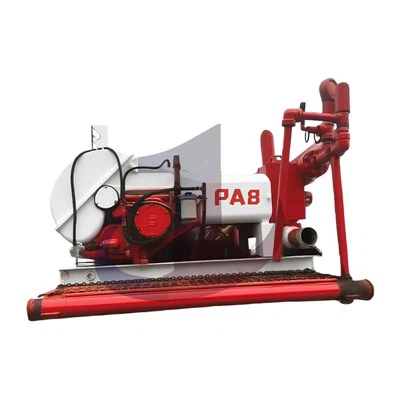
While the PA8/PAH platform is smaller than typical main drilling mud pumps (such as the 750 BHP PZ8), it proves highly effective for workover rigs, small-bore drilling operations, and auxiliary services.
In this role, pumps typically use a larger piston/liner configuration (4.5 to 5.0 inches) to maximize volumetric flow rate for circulating the drilling fluid, and operating pressure is typically below the safety threshold of 4,000 PSI.
C. Field integration and mobility
The PA8/PAH platform is specifically engineered for mobility, typically mounted on robust field skids and paired with heavy-duty mechanical drive systems (diesel engines and multi-speed transmissions). This configuration delivers reliable torque output in challenging terrains, making it essential for remote operations lacking sophisticated electrical infrastructure.
Connection Specifications: The pump employs standard API flanges for both discharge and suction manifold connections. High-pressure applications typically utilize smaller discharge flanges (e.g., 2-inch), which are suitable for low-flow/high-pressure requirements. The equipment is compatible with renowned industrial diesel engines (such as the Detroit 8V71/60 series), enhancing overall durability and resale value.


Redline Ecosystem and Selection Guide for Fragile Parts
piston and rod system
- Piston: A standard rubber piston will rapidly fail under 7500 PSI of high temperature and high shear force, resulting in heel extrusion.
Recommended Selection: The Bonded Urethane Piston (e.g., Green Duo or Supreme series) is mandatory. Polyurethane offers superior tear resistance and thermal stability. For oil-based mud or high-temperature wells (>200°F), consider using hydrogenated nitrile rubber (HNBR).
Design: High-pressure pistons typically feature a bullnose design to ensure precise centering during the stroke.
- Piston Rod: Part No.6278-25.
The surface should be coated with chromium or ceramic to resist corrosion and wear.
Connection method: The crosshead is connected via a sub-rod. The sub-rod is available in two types: clamp-type (part number 6279-1) and screw-type (part number 6280-1). The clamp-type allows for quicker assembly and disassembly.
Cooling device: A piston rod clamp with a water jacket (part number 1277CW) must be provided to ensure the coolant can spray directly onto the back of the piston rod, removing friction heat.
liner technology
- Material Revolution: During the 5000 PSI era, bimetallic liners (with high-chromium cast iron liners) were the industry standard. However, their service life was drastically reduced at 7500 PSI. Zirconia ceramic liners have now become the standard for 7500 PSI applications.
Performance comparison: The inner wall of ceramic cylinder liner can reach hardness above HRC 90, with extremely smooth surface and very low friction coefficient. Its service life is usually 5-10 times that of metal cylinder liner, greatly reducing the frequency of shutdown for replacement.
- Sealing: The liner seal (part number 2930-XXU) must be made of polyurethane. Ordinary rubber O-rings will be instantly 'bit' in high-pressure gaps.
Valves and Seats
- Specifications: The PZ-11 utilizes an API-7 standard valve body.
- Structure: The recommended valve type is the fully-open (Full-Open / Wing Guided) design. Traditional ribbed seat valves, which are prone to turbulence and erosion due to high flow resistance, have been phased out at 7500 PSI. The fully-open design ensures smooth flow channels, with the valve body securely positioned by guide claws, providing excellent stability.
- Rubber: The valve rubber (Insert) is critical for sealing. Bonded Urethane is recommended. The bonded design prevents the rubber from detaching from the valve body under high-velocity reverse flow impact.
post sale interchangeability
Key After-Sales Suppliers and Compatibility
In addition to OEM (Gardner Denver), several renowned manufacturers provide fully interchangeable hydraulic end components:
- Southwest Oilfield Products: Provides hydraulic end assemblies with part number 8477-25A, fully compliant with OEM specifications.
- Premium Oilfield & Rig Parts: Featuring the Mission L design and proprietary Caliber series modules, all explicitly certified for PZ-11 and PX-11 compatibility.
- TSC Manufacturing: The hydraulic end module of the WF1600L pump is interchangeable with the PZ-11.
Appendix: Detailed Reference Data Table
Table 1: General Specifications for the PZ-11 Power End
|
Parameter |
Specification value |
|
Pump type |
Triplex Single-Acting Piston Pump |
|
rated input power |
1,600 BHP (1,193 kW) |
|
maximum speed |
115 RPM (SPM) |
|
stroke length |
11 inches (279 mm) |
|
gear reduction ratio |
4.38:1 |
|
maximum load on connecting rod |
150,300 lb (68,175 kg) |
|
Inhalation tube flange |
10 "or 12" (usually) |
|
discharge pipe flange |
5 "5000 PSI or 4" 10000 PSI (depending on module configuration) |
Table 2: Key Hydraulic Component Part Numbers for 7500 PSI (Refer to Southwest/OEM)
|
Component name |
Typical part number |
Notes |
|
hydraulic end module (double head bolt type) |
300PZL2039 / 8477-25A |
Rated at 7500 PSI, forged alloy steel |
|
ceramic cylinder liner |
1367Y-XX (XX stands for size) |
The "Y" represents the type and must be used with ceramic material specifications. |
|
piston rod |
6278-25 |
Chromed or coated, with nut |
|
piston rod nut |
API-4 ESN |
Elastic Stop Nut |
|
cap seal ring |
P115 / P115U |
P115 is nitrile, and P115U is polyurethane (recommended). |
|
manifold guide bushing |
4700I |
Replacement plugin |
|
Wear plate |
8477-30 |
Module protection for critical components |
|
cylinder liner seal ring |
2930-XXU |
Polyurethane material, high pressure extrusion resistant |
Hot Tags: gardner denver px-11 - 7500 psi oem module pump, China gardner denver px-11 - 7500 psi oem module pump manufacturers, suppliers, factory