

The impeller is installed in the pump casing and fastened to the pump shaft, which is directly driven by the motor. There is a liquid suction pipe in the center of the pump casing. The liquid enters the pump through the bottom valve and the suction pipe. The liquid discharge port on the pump casing is connected to the discharge pipe.
Before the pump is started, the pump casing is filled with the liquid to be transported; after starting, the impeller is driven by the shaft to rotate at high speed, and the liquid between the blades must also rotate with it. Under the action of centrifugal force, the liquid is thrown from the center of the impeller to the outer edge and gains energy, leaving the outer edge of the impeller at high speed and entering the volute pump casing. In the volute, the liquid slows down due to the gradual expansion of the flow channel, and part of the kinetic energy is converted into static pressure energy, and finally flows into the discharge pipe at a higher pressure and is sent to the required place. When the liquid flows from the center of the impeller to the outer edge, a certain vacuum is formed in the center of the impeller. Since the pressure above the liquid surface of the storage tank is greater than the pressure at the pump inlet, the liquid is continuously pressed into the impeller. It can be seen that as long as the impeller keeps rotating, the liquid will be continuously sucked in and discharged.
The working principle of the linear pump is different from any other pump. It uses the magnetic suspension principle and the spiral ring fluid mechanics structure to achieve fluid propulsion, that is, the shaft, shaft connection, and shaft sealing structure are eliminated. After starting, the current is converted into a magnetic field, and the magnetic field force drives the spiral ring to operate, that is, the spiral ring lifts the fluid forward.
Working Principle Of FMC Pump
Popular Products
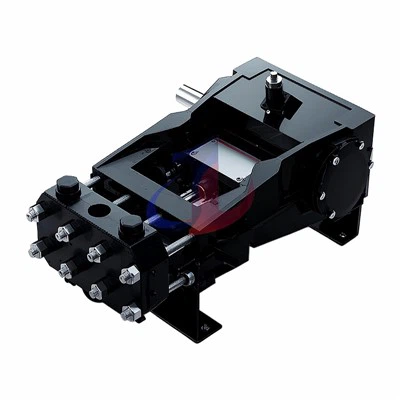
DL FR-50 GPM COMP HDD Pump
DL FR-50 GPM COMP High-Pressure Plunger Pump: Superior Performance, Robust DurabilityThe DL FR-50 GPM COMP is a newly

DL BEAN FR-70GPM HD HDD Pump
The DL FR-70 GPM HD high-pressure plunger pump is not just a power unit; it's a critical partner in ensuring your

NOV 14-P-220 OME 7500PSI Mud Pump
The power end is the heart of the Mud Pump, and its design and manufacturing quality directly determines the

NOV JWS-400 Caged Valves Pump
The NOV JWS-400 (cage valve) three-cylinder reciprocating workover pump is a strategic solution engineered to address

NOV JWS-340 Special Pump
JWS-340 SPECIAL is a reciprocating triplex pump designed for intermittent high-pressure operation. Its core performance

DL Sentinel Type C Reset Safety Valve
The trigger mechanism of the Titan C safety valve ingeniously employs the lever principle of a balance beam, which is

DL Safe-Set Hammerless Liner Retainer
Black-JAK Core Technology Analysis: The Engineering Basis of Superior Performance

DL Sentinel Type RRV 3 Inch 8000 PSl Reset Safety Valve
The core mechanism of this valve lies in its pop-action pressure relief capability. When pipeline pressure exceeds a